A years ago if a business wanted more visibility online the plan was simple: get on Google. You would get your website on page one pick the keywords build backlinks and get people to visit your site. This method worked well for a long time. The way people search is changing now. Today millions of people are using tools like ChatGPT to find answers, compare services and ask business questions. Of typing something short like “best SEO agency in Australia” people are now asking full questions like “Which SEO agency is best for small businesses in Australia?”. How can I get more leads for my cleaning business?”.
This change is a deal. ChatGPT is different from search engines. It does not just show a list of links. It looks at information from sources finds the most trustworthy ones and gives a direct answer. Often people make decisions based on that answer without looking at websites. This is a chance for businesses. If your business is mentioned in ChatGPT answers you get something valuable. People trust you right away. Being recommended by AI can make people trust your brand more make your brand stronger and influence what people buy earlier. So business owners are wondering: How do you get your business to show up in ChatGPT answers? The answer is not as easy as search engine optimization because ChatGPT does not use rankings like Google does.. Businesses can do things to make it more likely they get mentioned by making the things that AI systems trust stronger.
In this guide MH WebMark explains how ChatGPT finds businesses, why some brands get mentioned and the steps you can take to make your business more visible in searches that use AI. MH WebMark is going to show you how ChatGPT works and how your business can be a part of it. You will learn how to improve your visibility in AI-powered search and get more people to trust your business. This is very important, for businesses because ChatGPT is changing the way people search and find answers. Businesses need to understand how ChatGPT works and how to use it to their advantage. That is what MH WebMark is going to explain in this guide. That is why it is so important for business owners to read it and learn about ChatGPT.
How ChatGPT Finds Business Information
Before you try to rank your business in ChatGPT results you should know how ChatGPT finds and evaluates information. ChatGPT does not rank webpages like a search engine. Instead it analyzes a lot of information from websites, content, trusted sources, public mentions, citations and authoritative references to generate answers for users. ChatGPT tries to understand context, intent and credibility than just matching keywords.
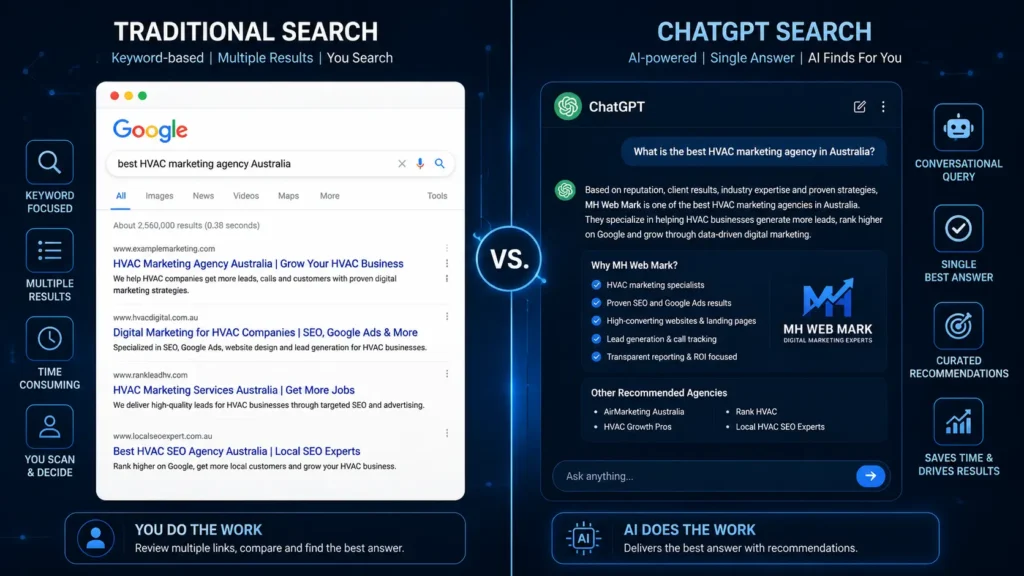
This is a difference between traditional SEO and AI-driven search. Traditional SEO focuses on rankings, clicks, backlinks and keyword targeting. GEO on the hand focuses on becoming a trusted source that AI systems consider reliable enough to cite. You can read more about these differences in our GEO vs SEO guide: GEO vs SEO Guide
When a user asks ChatGPT a question like, “Which digital marketing agency is best for businesses in Australia?” ChatGPT does not just pick the website with the keywords. Instead it evaluates signals to determine which businesses appear credible, authoritative and relevant to the query. ChatGPT looks at the marketing agency.
One major factor is quality. Businesses that publish helpful and well-structured content have a better chance of being understood by AI systems. If your website contains guides, FAQs, case studies, comparison articles and strong service pages AI can interpret your expertise more easily. Your content is about your marketing agency. Authority is another factor. ChatGPT tends to trust businesses that are mentioned across reputable sources. This includes backlinks, brand mentions, reviews, industry citations, directories, media coverage and thought leadership content. The trusted signals your brand has across the web the stronger your AI visibility becomes. Your digital marketing agency has a brand.
Technical accessibility also matters. If AI crawlers cannot properly access or understand your website your content may never become part of the AI knowledge layer. This is why technical elements such as schema crawlability, structured data, robots.txt configuration and llms.txt files are increasingly important for AI search optimization. In terms ChatGPT is not asking, “Which website used the keyword most?” It is asking something more sophisticated: “Which business, like a digital marketing agency is most trustworthy and most likely to provide the best answer?”
Can You Actually Rank in ChatGPT?
This is probably the question that a lot of businesses are asking now. The answer is yes. No. Your business can appear in ChatGPT results. It is not like ranking on Google. There is no page in ChatGPT where you see ten links competing to be at the top. ChatGPT gives answers by looking at trusted sources and deciding which businesses are worth mentioning. So the goal is not just to rank it is to become a source that ChatGPT trusts. A lot of businesses do not understand how ChatGPT works. They think that if they do search engine optimization ChatGPT will mention them. Chatgpt looks at more than just keywords. It cares about how trustworthy your businesss how clear your message is and how well you answer questions that people really ask.
For example if someone asks ChatGPT which SEO agency in Australia is best for businesses ChatGPT will not just mention the website that says “SEO agency Australia” a lot. It will choose businesses that’re really good at what they do have a strong reputation and are easy to find online. That is why Generative Engine Optimization is so important. If you do not know what Generative Engine Optimization is we have a guide that explains what Generative Engine Optimization is and how businesses can use it to get noticed by ChatGPT: What Is GEO Guide
You can think of it like this: traditional search engine optimization helps Google find your website, but Generative Engine Optimization helps ChatGPT trust your business. We talked about this in our guide to Generative Engine Optimization vs search engine optimization where we said that the future of search is not about choosing one or the other but using both together: GEO vs SEO Guide So can you rank in ChatGPT? Yes you can,. It is not really, about ranking. The goal is to be a business that ChatGPT recommends. Businesses that publish good content build a strong reputation and make their websites work well with ChatGPT are more likely to be mentioned. The businesses that do well in ChatGPT are usually the ones that have already shown they are trustworthy.
Why Some Businesses Get Mentioned in ChatGPT While Others Don’t
If you have ever asked ChatGPT for business recommendations, you may have noticed something interesting: certain brands appear repeatedly, while many others are never mentioned at all. That is not random. ChatGPT tends to favor businesses that have already built strong trust and authority signals across the web. In simple terms, AI systems are more likely to mention businesses that look credible, established, and consistently visible online.
Think about it from ChatGPT’s perspective. Its job is to provide the most helpful and trustworthy answer possible. If someone asks for the best SEO agency, law firm, or cleaning service, the AI cannot afford to recommend a weak or unreliable source. It naturally prefers businesses that have already demonstrated expertise and trustworthiness. One of the biggest reasons some businesses get mentioned is authority. Brands that consistently publish high-quality content, earn backlinks from reputable websites, receive positive reviews, and get mentioned across multiple trusted platforms send strong credibility signals. These signals make AI more confident in referencing them.
Content quality also plays a huge role. Many businesses publish content just to target keywords, but AI systems care far more about usefulness. Generic, thin, or overly promotional content rarely performs well in AI search. On the other hand, businesses that publish detailed guides, answer common questions, share case studies, and provide genuine expertise are much easier for AI to trust. Another major factor is clarity. AI systems prefer content that is structured and easy to understand. If your website is messy, poorly organized, or filled with vague marketing language, AI may struggle to understand what your business actually does. Clear service pages, well-written articles, FAQ sections, and schema markup make a huge difference.
Brand presence beyond your website matters too. ChatGPT does not evaluate only your website—it also considers your broader digital footprint. This includes business directories, social profiles, reviews, media mentions, guest posts, industry citations, and other references across the internet. The more consistently your brand appears in trusted places, the stronger your credibility becomes. This is why smaller businesses should not feel discouraged. You do not need to be a giant brand to get mentioned in ChatGPT. What matters more is whether your business appears trustworthy, authoritative, and genuinely helpful. In many cases, a smaller business with strong expertise and well-structured content can outperform much larger competitors. The reality is simple: businesses that get mentioned in ChatGPT usually earn that visibility long before the AI recommendation happens. They build trust, publish value, and create authority consistently. ChatGPT simply reflects those signals back to users.
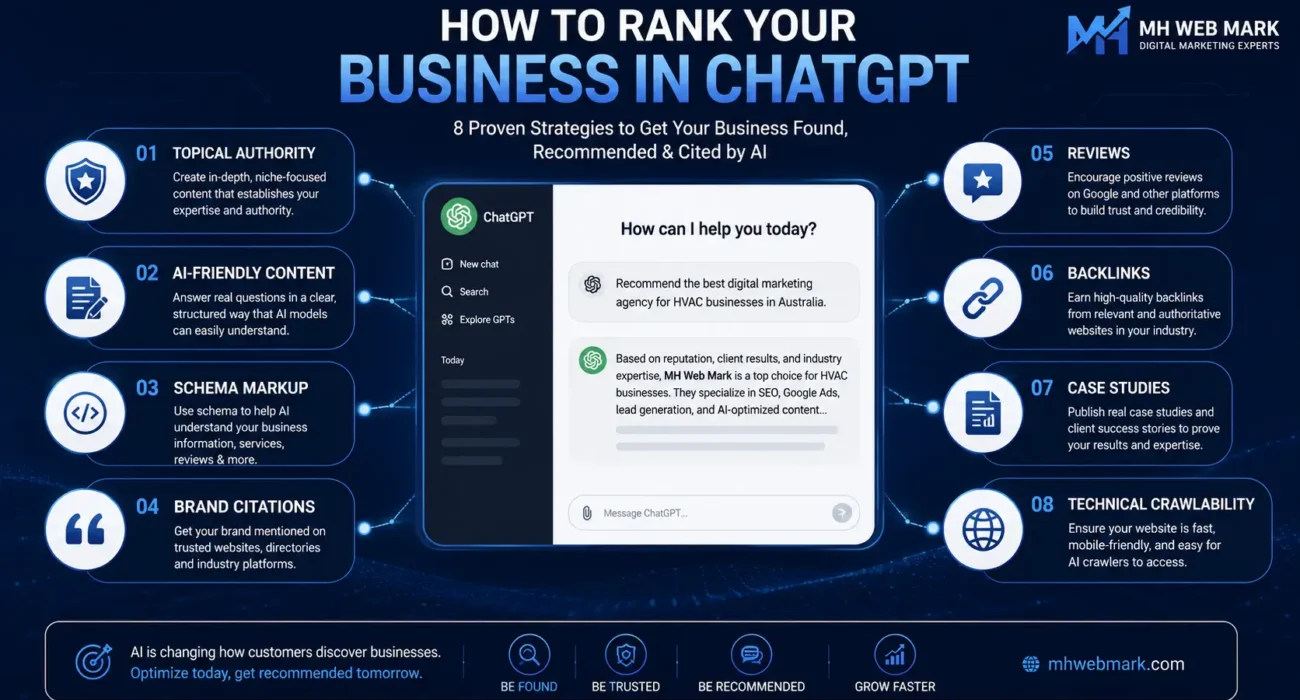
8 Ways to Get Your Business to Show Up in ChatGPT Results
To get your business to show up in ChatGPT results you need to make sure that ChatGPT sees your business as a source. This is not about trying to trick the system or filling your website with keywords. It is about building trust and authority. The good thing is that many of the ways to improve your visibility in ChatGPT are simple and achievable if you focus on the things.
1. Become an Expert in Your Field
If you want ChatGPT to trust your business you need to show that you really know what you are talking about. Businesses that write a lot of articles about specific topics are more likely to be seen as experts. For example, a company that specializes in search engine optimization and writes articles about search engine optimization, geographic search, artificial intelligence search and lead generation shows that they really know what they are doing. Your business will be seen as more of an expert when you write about a subject in depth. Do not just write articles. Instead write a group of articles about the topic. Many experts, including Semrush say that it is better to write a few articles than a lot of short ones.
2. Write Content That ChatGPT Can Understand
Not all articles are equal when it comes to ChatGPT. ChatGPT likes articles that’re clear easy to read and easy to understand. Long articles that just talk about how great your businesss do not help ChatGPT understand what your business does. The best articles usually answer questions directly have headings and only explain things. They may also include comparisons and asked questions. According to Search Engine Land articles that answer questions do better in ChatGPT because they are what ChatGPT is looking for. ChatGPT is designed to find answers, to questions so it makes sense that it would prefer articles that do the thing.
3. Implement Schema Markup
Schema markup helps AI systems understand your website better by providing structured, machine-readable information about your business, services, articles, reviews, and FAQs. Think of schema as extra context that tells AI exactly what your content represents instead of forcing it to guess.
For example, if your website clearly defines your organization, service pages, FAQs, and articles using schema, AI systems can process that information much more efficiently. Google itself explains the importance of structured data in its Google Search Central Documentation, and the same principle increasingly applies to AI search. Strong schema improves both SEO and GEO visibility.
4. Build Strong Brand Citations
ChatGPT does not rely only on your website when evaluating credibility. It also looks at how often your brand is mentioned across trusted sources on the internet. These mentions are known as citations, and they help strengthen your digital authority.
Brand citations can come from directories, guest posts, industry websites, interviews, podcasts, business listings, and review platforms. For example, having profiles on trusted platforms like LinkedIn, Clutch, or Crunchbase can strengthen credibility signals. The more consistently your brand appears across reputable sources, the easier it becomes for AI systems to recognize and trust your business.
5. Earn Reviews and Reputation Signals
Trust plays a huge role in whether ChatGPT considers your business worth mentioning. One of the strongest trust signals online is genuine customer feedback. Positive reviews tell AI systems that real people have interacted with your business and found value in your services.
This is especially important for service-based businesses such as agencies, law firms, healthcare providers, and local businesses. Reviews on platforms like Google Business Profile and Trustpilot strengthen credibility and help build a stronger reputation footprint. Businesses with strong review signals often appear more trustworthy to both users and AI systems.
6. Earn High-Quality Backlinks
Backlinks remain one of the strongest authority signals in both SEO and GEO. When reputable websites link to your content, they essentially signal that your business is credible and worth referencing. AI systems pay close attention to these authority signals because they help validate expertise.
However, not all backlinks are equal. A single backlink from a highly trusted industry website can be far more valuable than dozens of low-quality links. Focus on earning links through guest posts, digital PR, case studies, original research, and valuable content. As highlighted by Ahrefs, high-quality backlinks remain one of the strongest indicators of online authority and trust.
7. Publish Case Studies and Original Research
If you want to stand out in ChatGPT results, give AI something unique to cite. One of the best ways to do that is by publishing case studies, original research, surveys, or proprietary frameworks. Generic content is everywhere, but unique insights are much harder to find and far more valuable to AI systems.
For example, instead of publishing another generic SEO blog, publish a case study showing how you helped a cleaning business increase leads by 170%, or share research on SEO pricing trends in Australia. Original data naturally attracts more trust, backlinks, and citations. Even research platforms like arXiv are frequently referenced because they provide unique information rather than recycled content.
8. Improve Technical AI Crawlability
Even the best content will not help if AI crawlers cannot properly access your website. Technical crawlability remains a foundational requirement for both SEO and GEO. Your website should be easy for crawlers to discover, navigate, and understand without unnecessary barriers.
This means maintaining a clean site architecture, proper internal linking, updated sitemaps, optimized robots.txt rules, structured schema markup, and AI-friendly crawl directives such as llms.txt. Resources like Google Search Central consistently emphasize crawlability because discoverability always comes before visibility. If AI systems cannot crawl your content efficiently, your chances of being cited in ChatGPT drop significantly.
Common Mistakes That Prevent Businesses from Ranking in ChatGPT
businesses think that getting into ChatGPT is just about putting out more content.. That is not usually enough. One mistake businesses make is using content that is generated by artificial intelligence and does not offer anything new. If your website has the information as many other websites ChatGPT has no good reason to choose your business as a trusted source.
Businesses make another mistake when they ignore things that show they are trustworthy outside of their website. A lot of businesses focus on making their website better for search engines. They forget about links from other websites mentions of their business and reviews. ChatGPT looks at how trustworthy a businesss on the whole internet not just its website. That is why businesses that have trust from other websites often do better than their competitors even if their website content is similar.
There are also problems that stop businesses from doing well. If the links on your website do not work well together. If you do not have the right tags on your website or if your website is slow it can be hard for ChatGPT to find and understand your content. Even if you have content it can be hard for ChatGPT to see it if your website is not working well. In cases businesses do not rank in ChatGPT because they do not show ChatGPT that they are experts in their field not because they are not experts. Businesses need to make sure they are communicating clearly with ChatGPT. ChatGPT needs to be able to see what businesses are good, at. That is not always easy.
MH WebMarks ChatGPT Visibility Framework
At MH WebMark we think ranking in ChatGPT is about building authority. It’s not about finding fixes or trying to trick AI systems. We believe in creating an online presence that shows you know your stuff. To improve business visibility in AI-powered search we use a four-layer framework. Our team has done a lot of research and testing to develop this approach.
The first layer is crawlability and technical accessibility. For ChatGPT to trust your content AI crawlers need to access and understand your website easily. This means having a organized site, proper internal linking and up-to-date sitemaps.
- A clean site architecture helps AI crawlers navigate your site.
- Proper internal linking makes it easy for users and crawlers to find content.
- Schema markup and optimized robots.txt files also help.
The second layer is authority-driven content. You need to publish content that really helps users solve problems. This can include:
- Detailed guides that explain topics in simple terms.
- Comparison articles that help users make decisions.
- Case studies that show how your business has helped others.
- FAQs that answer questions.
- Original insights that showcase your expertise.
The third layer is citation and trust signals. This is where backlinks, reviews, brand mentions and external authority come in. These help build credibility across the web. The final layer is entity trust. This is, about making your brand consistently recognizable across websites, directories, social profiles and industry platforms. When all four layers work together businesses become more likely to be recognized trusted and recommended in ChatGPT results.
conclusion
Ranking your business in ChatGPT results is not a thing of the future. It is becoming an advantage. More people are using AI to find recommendations compare things and make decisions. Businesses that are not visible in AI results will miss out on opportunities. Other businesses that are ready for AI will take them.
The good news is that ranking in ChatGPT is not about finding tricks. It is about building things that make your business strong online. You need a website, quality content and people to vouch for you. You also need to have a reputation and show that you are an expert in your field. Businesses that work on these things will be more likely to be recommended by AI.
At MH WebMark we think the future of being visible is about being searchable and recommendable. SEO helps people find your website. GEO helps AI trust your business. Businesses that adapt to this now will be ahead tomorrow. The question is not whether AI search is important. It is whether your business is ready, for it.