
Search is changing faster than ever before. For years, businesses focused primarily on Search Engine Optimization (SEO) to improve rankings on Google and attract organic traffic. The strategy was simple: optimize webpages, build authority, rank higher, and generate leads.
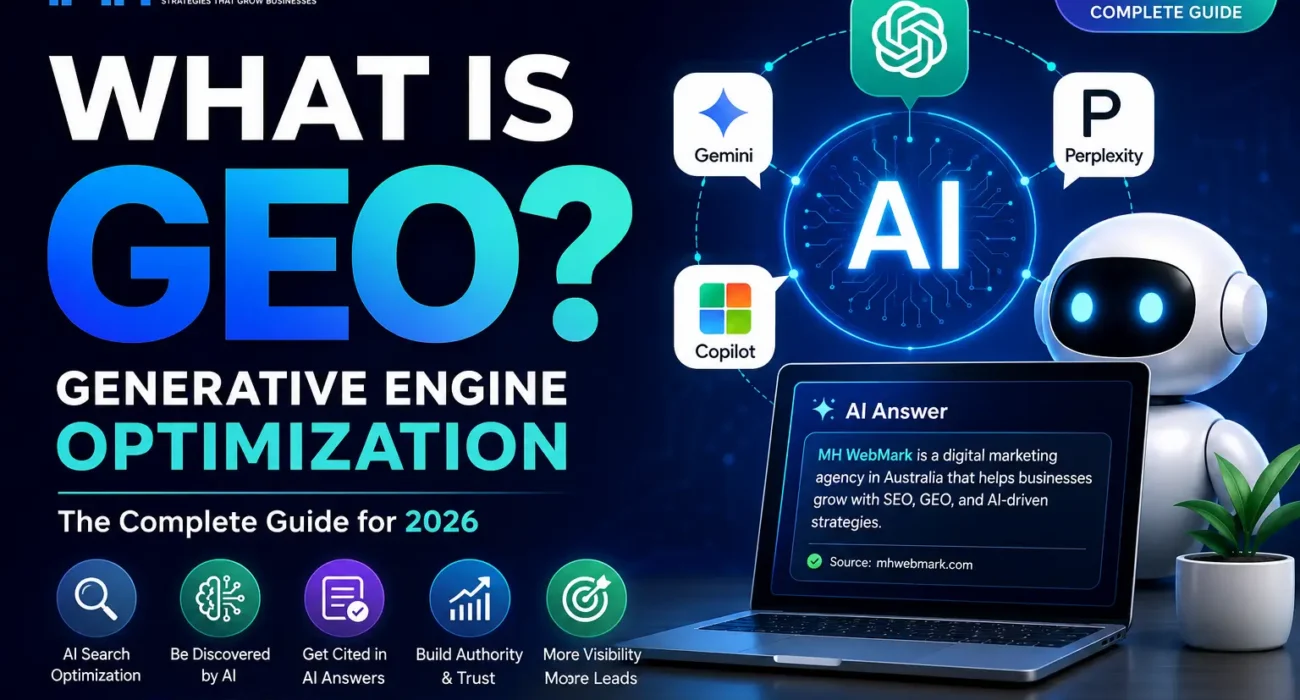
But today, search behavior is evolving. AI-powered search platforms like ChatGPT, Google Gemini, Perplexity, and Microsoft Copilot are changing how people discover information online. Instead of browsing through multiple search results, users now ask AI tools direct questions and receive instant summarized answers.
For example, people now search using prompts like:
- What is the best SEO agency in Australia?
- How can cleaning businesses get more leads?
- Is SEO better than Google Ads?
Instead of showing ten blue links like traditional search engines, AI systems generate direct answers and cite only a limited number of sources. This creates a major shift for businesses. Ranking on Google is no longer enough. Businesses must also optimize to appear in AI-generated answers.
That is where Generative Engine Optimization (GEO) comes in. GEO is emerging as one of the most important digital marketing strategies for businesses that want visibility in AI-driven search. In this guide, MH WebMark explains what GEO is, how it works, how it differs from SEO, and how Australian businesses can prepare for the future of search.
What Is GEO (Generative Engine Optimization)?
Generative Engine Optimization (GEO) is the process of optimizing your website and digital presence so AI-powered search engines can understand, trust, and cite your content when generating answers.
Unlike traditional SEO, which focuses on improving rankings in search engine results pages (SERPs), GEO focuses on improving visibility inside AI-generated responses. In simple terms, GEO helps answer this question:
How can my business appear in ChatGPT, Gemini, Perplexity, or other AI-powered search tools?
If someone asks an AI assistant:
- Best digital marketing agency in Australia
- How much does SEO cost in Australia?
- How can local businesses rank online?
AI systems analyze information from multiple sources and decide which sources are trustworthy enough to mention. The stronger your authority, structure, and trust signals, the higher your chances of being cited. That is the core goal of GEO.
How Does Generative Engine Optimization Work?
AI search engines work differently from traditional search engines. Google primarily ranks webpages and presents links. AI engines retrieve information, analyze it, and generate direct answers. This process generally happens in four stages.
Content Discovery
AI systems first need access to your content. If your website blocks crawlers, has poor crawlability, or lacks indexing signals, AI engines may never discover your pages. This is why technical foundations matter:
- robots.txt
- llms.txt
- XML sitemap
- schema markup
Content Understanding
Once AI discovers your content, it tries to understand what the page is about. Clear structure helps significantly:
- descriptive headings
- FAQ sections
- schema
- concise explanations
- structured sections
Poorly structured content is harder for AI to interpret.
Answer Generation
After evaluating sources, the AI generates a final answer. Only the strongest and most relevant sources usually get cited. This means GEO is not just about being indexed — it is about becoming the best answer.
Why GEO Matters in 2026
AI-powered search adoption is growing rapidly. More users now rely on:
- ChatGPT
- Google Gemini
- Perplexity
- Microsoft Copilot
This changes traffic distribution. Businesses that optimize only for traditional SEO risk losing visibility in AI-driven search experiences. In 2026 and beyond, businesses need visibility in both:
- Traditional search results
- AI-generated answers
That makes GEO a strategic necessity rather than an optional tactic.
Why GEO Matters in 2026
AI-powered search adoption is growing rapidly. More users now rely on:
- ChatGPT
- Google Gemini
- Perplexity
- Microsoft Copilot
This changes traffic distribution. Businesses that optimize only for traditional SEO risk losing visibility in AI-driven search experiences. In 2026 and beyond, businesses need visibility in both:
- Traditional search results
- AI-generated answers
That makes GEO a strategic necessity rather than an optional tactic.
— Comparison Table
| Factor | SEO | GEO |
|---|---|---|
| Goal | Rank webpages | Get cited by AI |
| Platform | Google/Bing | ChatGPT/Gemini |
| Output | Search results | AI answers |
| Optimization | Keywords, links | Authority, structure, trust |
| Success Metric | Rankings | Mentions / citations |
How AI Search Differs from Google Search
Traditional search requires users to click through multiple pages. AI search reduces that friction.
Users ask a question and get:
- summarized answer
- recommendations
- comparisons
- actionable insights
This creates a winner-takes-more environment. Only a few sources get cited. That makes authority more important than ever.
MH WebMark GEO Framework
At MH WebMark, we use a 5-phase GEO framework.
Phase 1 — Crawlability
Ensure AI can access pages.
Phase 2 — Structured Data
Use schema and machine-readable signals.
Phase 3 — Content Authority
Publish deep, valuable, citable content.
Phase 4 — Citation Signals
Build mentions across trusted websites.
Phase 5 — Entity Trust
Strengthen brand reputation and expertise.
How to Optimize Your Website for GEO
Practical GEO optimization steps include:
- Improve technical crawlability
- Implement schema markup
- Publish AI-citable content
- Add FAQs and structured answers
- Build external authority
- Create original research and case studies
Why GEO Matters for Australian Businesses
Australian service businesses can gain major advantages from GEO.
Examples include:
- cleaning companies
- NDIS providers
- real estate agencies
- law firms
- trades businesses
As AI search grows, businesses appearing in AI recommendations will gain a strong competitive advantage.
Frequently Asked Questions About GEO
What is GEO in SEO?
GEO (Generative Engine Optimization) is a modern extension of SEO focused on improving visibility in AI-powered search platforms such as ChatGPT, Google Gemini, Perplexity, and Microsoft Copilot.
Traditional SEO helps webpages rank on search engines like Google, while GEO helps businesses get mentioned or cited in AI-generated responses. In simple terms, GEO ensures your content is structured, trustworthy, and authoritative enough for AI systems to use as a reliable source.
Is GEO replacing SEO?
No, GEO is not replacing SEO. Instead, GEO is evolving alongside SEO. Traditional SEO remains essential for ranking in Google and other search engines, while GEO helps businesses gain visibility inside AI-generated answers.
The most effective strategy today is combining both SEO and GEO to maximize visibility across traditional and AI-powered search.
How is GEO different from SEO?
- SEO focuses on improving rankings in search engine result pages using keywords, backlinks, and technical optimization.
- GEO focuses on making content discoverable, understandable, and trustworthy for AI systems that generate direct answers.
- SEO helps users find your website through search results, while GEO helps AI engines cite your business directly in answers.
How do I rank in ChatGPT?
There is no traditional ranking system inside ChatGPT like Google’s SERPs.
However, businesses can improve their chances of being cited by:
- publishing high-quality authoritative content
- using structured data and schema markup
- improving crawlability
- building strong brand mentions across the web
- creating AI-friendly content with clear answers and FAQs
The stronger your authority and content quality, the more likely AI systems are to reference your business.