
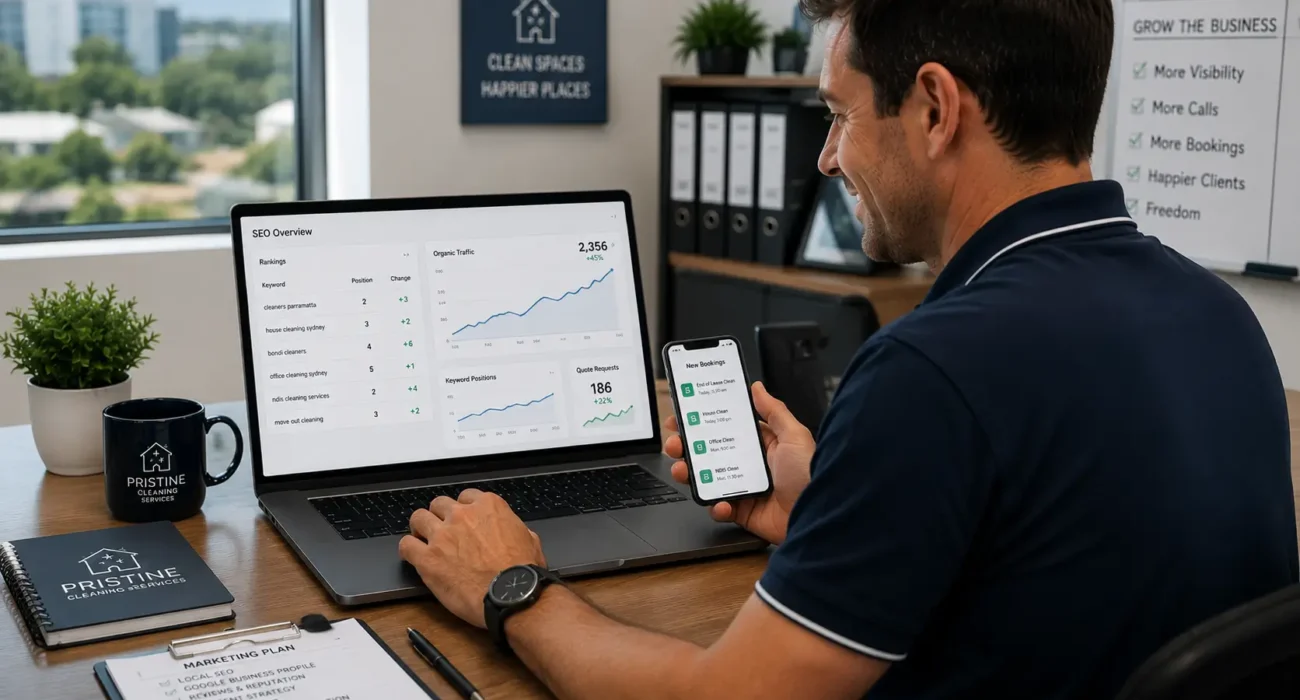
At MH WebMark, we’ve worked with enough service-based businesses to notice a recurring pattern: many cleaning companies offer excellent service, have happy clients, and deliver consistent results—yet they still struggle to generate leads from Google. In most cases, the issue isn’t service quality. It’s search visibility. Today, most customers begin their buying journey online. Whether someone needs office cleaning, residential cleaning, carpet cleaning, or end-of-lease services, their first step is usually a Google search. If your cleaning business doesn’t appear when those searches happen, you’re losing opportunities before potential clients even know you exist.
This is where SEO becomes critical. SEO for cleaning services is not simply about ranking for more keywords. It’s about ranking for the right searches—the searches made by people actively looking for cleaning services in your service areas. That distinction matters because traffic alone doesn’t grow a cleaning business. Qualified traffic does.
A website ranking for irrelevant keywords may receive visitors but generate few enquiries. On the other hand, ranking for high-intent local searches can consistently produce quote requests and bookings. That’s why the best SEO strategies focus on visibility, relevance, and conversion together. If you’ve already read our guides on Cleaning Business Marketing or Local Marketing for Cleaning Businesses, you know that digital growth happens when multiple channels work together. SEO sits at the center of that system because it helps cleaning businesses capture demand exactly when potential customers are searching.
Why Many Cleaning Businesses Struggle to Rank on Google
Many cleaning businesses assume that ranking on Google is simply a matter of having a website and adding a few keywords. Unfortunately, SEO is far more competitive than that. Google doesn’t rank businesses based only on who offers good cleaning services. It ranks websites based on relevance, trust, authority, and user experience. This means even highly capable cleaning companies can struggle to appear in search results if their SEO foundations are weak.
The frustrating part is that many business owners don’t know why they’re underperforming. They see competitors ranking above them and assume those businesses must be bigger or spending more. Sometimes that’s true—but often the real reason comes down to better SEO execution.
Weak Website Structure
One of the most common SEO problems for cleaning businesses is poor website structure. Many cleaning company websites are built with only a homepage, a contact page, and perhaps one generic services page. While this may be enough to establish an online presence, it’s rarely enough to rank competitively in search.
Google prefers websites with clear structure and strong topical relevance. That means your website should help search engines understand:
- what services you offer
- who those services are for
- which locations you serve
- how pages relate to each other
A poorly structured website creates confusion. For example, if all services are bundled into one generic page, Google has difficulty understanding whether your business is relevant for searches related to office cleaning, carpet cleaning, or end-of-lease cleaning. That weakens ranking potential. Strong structure improves crawlability, relevance, and user experience—all of which influence SEO.
Poor Local SEO Signals
For cleaning businesses, local SEO is often the difference between visibility and invisibility. Most customers search for nearby providers. They want businesses operating in their city, suburb, or service area. That means Google pays close attention to local relevance signals. When those signals are weak, rankings suffer.
Common weak local SEO signals include:
- incomplete Google Business Profile
- inconsistent business information
- weak review profile
- poor local citations
- missing location pages
These issues make it harder for Google to trust your business as a strong local result. For example, if your website says one service area while directory listings show another, Google receives mixed signals. That inconsistency can hurt rankings.
Strong local SEO tells Google something important: This business is legitimate, relevant, and highly connected to this local market. That improves visibility for high-intent local searches.
Targeting the Wrong Keywords
This is one of the most expensive SEO mistakes cleaning businesses make. Many business owners focus on keywords that sound important rather than keywords that generate bookings. There’s a major difference between ranking for broad informational terms and ranking for high-intent service searches.
For example, a keyword like “cleaning tips” may attract traffic, but that traffic often includes people looking for DIY advice rather than cleaning services. Compare that to searches like:
- office cleaning Sydney
- commercial cleaners Parramatta
- end-of-lease cleaning near me
These searches show strong buying intent. The users behind them are much closer to becoming customers. This is why keyword strategy matters so much. Good SEO doesn’t chase every keyword. It prioritizes keywords that align with customer intent and business growth.
Understand How Customers Search for Cleaning Services
One thing many cleaning business owners overlook is how differently customers search depending on what they need. This matters because SEO becomes much easier when you understand search behavior. Many people think customers simply search “cleaning services” and choose a business. In reality, search behavior is much more specific than that. A residential customer searching for weekly house cleaning behaves differently from a facility manager looking for commercial cleaners. Someone moving out of a rental property searches differently again.
For example, a homeowner might search:
- house cleaners near me
- weekly home cleaning Sydney
- affordable cleaners nearby
These searches usually focus on convenience, trust, and price. Now compare that to a commercial client. An office manager or property manager may search:
- office cleaning company Melbourne
- commercial cleaners Parramatta
- strata cleaning services Sydney
These searches are different because commercial buyers often care more about reliability, professionalism, insurance, and long-term contracts. Then you have end-of-lease customers. These searches are often urgent:
- bond cleaning Blacktown
- move out cleaning near me
- end of lease cleaners today
These users usually want fast service and quick booking. Why does all this matter? Because different searches mean different intent. And different intent requires different SEO strategy. A cleaning business that understands customer intent can create pages and content specifically designed to match what potential clients are actually searching for. That gives Google clearer signals and improves your chances of ranking for valuable keywords.
Good SEO starts with understanding your customer—not Google. Because once you understand what people are searching for and why, optimizing for search becomes much more strategic.
SEO Starts With the Right Keyword Strategy
One of the biggest mistakes in SEO is targeting keywords based purely on search volume. Higher volume sounds attractive, but volume alone can be misleading. A keyword may get lots of searches and still bring very poor leads. What matters more is intent. The best SEO strategies focus on keywords that attract people who are genuinely close to booking. I usually think about cleaning SEO keywords in three layers. The first layer is service keywords. These describe what you actually offer.
Examples include:
- office cleaning
- carpet cleaning
- end-of-lease cleaning
- commercial cleaning
- residential cleaning
These are your core service keywords. The second layer is location keywords. These tell Google where you operate. Examples include:
- Sydney
- Melbourne
- Parramatta
- Blacktown
- Chatswood
Location signals are essential because cleaning services are highly local. The third layer is intent keywords. These reveal buying readiness. Examples include:
- quote
- near me
- price
- same day
- book now
These often indicate strong commercial intent. Let’s compare two keywords. Keyword one: best cleaning hacks Keyword two: office cleaning quote Sydney Which one is more likely to generate a booking? The answer is obvious. The second keyword may have lower search volume, but the buyer intent is far stronger. That’s why good SEO doesn’t chase traffic blindly. It prioritizes traffic that can turn into enquiries.
At MH WebMark, we focus heavily on identifying these high-value keywords because they help businesses rank for searches that actually produce revenue—not just website visits.
Optimize Your Website for Rankings and Conversions
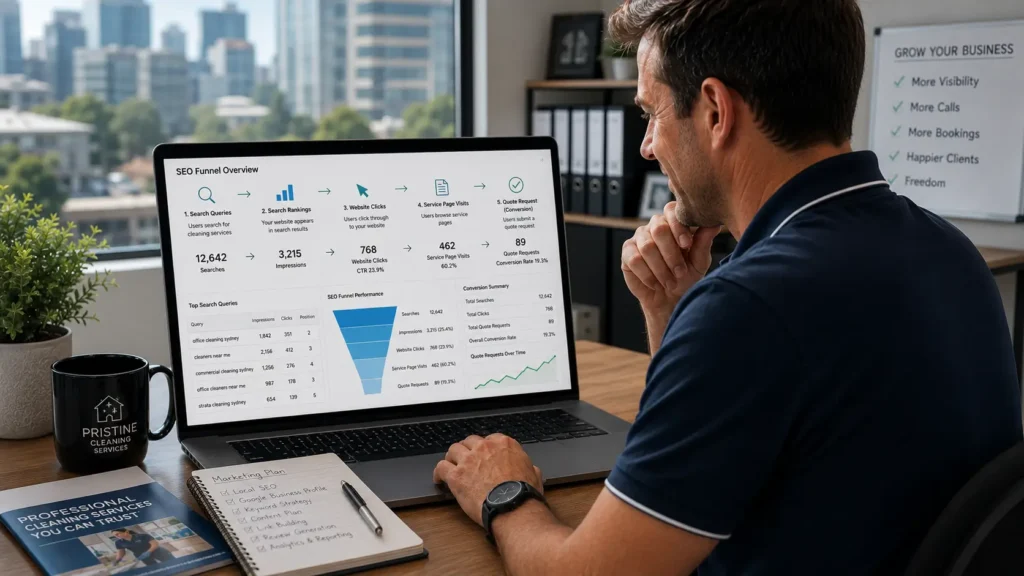
Many cleaning businesses think SEO ends once traffic starts increasing. It doesn’t. Traffic is only part of the equation. What happens after someone lands on your website matters just as much. I’ve seen businesses rank well on Google but still struggle with leads because their website fails to convert visitors into enquiries. Think about it from a customer’s perspective. Someone clicks your website from Google and lands on your homepage.
Within seconds, they’re asking themselves:
- Am I in the right place?
- Do these people offer the service I need?
- Can I trust them?
- How do I contact them?
If the answers aren’t clear quickly, they leave. And when visitors leave without interacting, your SEO traffic loses business value. Professional SEO and Digital Marketing Services help ensure your website is not only visible in search results but also capable of turning visitors into qualified enquiries. Speed matters. If pages load slowly, users bounce. Mobile experience matters even more. Most local service searches happen on mobile devices, so if your site feels clunky on phones, conversion drops fast. Trust signals matter too.
Customers feel more confident when they see:
- strong reviews
- testimonials
- before-and-after photos
- clear service information
- professional design
Your calls-to-action also matter. A visitor should never wonder what to do next. Whether it’s:
- request a quote
- call now
- book consultation
the next step should feel obvious. This is something we explored deeply in our guide on Website Marketing for Cleaning Services, because even strong SEO becomes less effective when the website itself creates friction. Here’s a simple truth many businesses miss: Ranking gets attention. Conversion gets bookings. You need both.
Local SEO Is Critical for Cleaning Services
If there’s one area of SEO that cleaning businesses simply cannot ignore, it’s local SEO. The reason is straightforward: cleaning is a highly location-based service. Someone searching for office cleaning in Sydney is not looking for a company in Perth, and a tenant needing end-of-lease cleaning in Parramatta wants a business that can actually serve that area. Google understands this behavior very well, which is why local relevance plays such a huge role in search rankings.
This is where many cleaning businesses lose valuable opportunities without even realizing it. They focus entirely on their website and overlook the local signals Google uses to decide which businesses appear in local search results and Google Maps. When someone searches for cleaners near them, Google often shows the local map pack before traditional website results. Those top map listings attract a massive share of clicks, calls, and enquiries. If your business isn’t visible there, you’re missing some of the highest-intent leads available.
We explored this in greater detail in our guide on Local Marketing for Cleaning Businesses, where we explain how map visibility and service-area targeting directly impact lead generation. By making it easier for Google to understand three key things: your business is legitimate, you genuinely operate in the searched location, and customers trust your service. Google evaluates this using multiple signals such as your Google Business Profile, customer reviews, business citations, local content, and service-area relevance. Your Google Business Profile is especially important because many customers interact with it before ever visiting your website. They check ratings, reviews, photos, business hours, and service details to decide whether your business feels trustworthy. That means local SEO doesn’t just improve rankings—it directly impacts customer trust and enquiry volume.
Another major ranking factor is consistency in your business information across the web. If your website, directories, and listings all show slightly different details, Google receives mixed signals. Even small inconsistencies can weaken trust and reduce visibility. In simple terms, strong local SEO makes it easier for both Google and customers to trust your business. For cleaning services, that trust often translates directly into more bookings.
Create Service Pages and Location Pages
One of the biggest SEO mistakes cleaning businesses make is expecting a single homepage to rank for everything. I see this all the time. A business wants one page to rank for office cleaning, commercial cleaning, carpet cleaning, end-of-lease cleaning, and every suburb they serve. Unfortunately, that approach rarely works well.
Google prefers specificity because users search with specific intent. If someone searches for office cleaning in Sydney, Google wants to show the most relevant page for that exact need—not a generic homepage mentioning multiple services and locations. This is why dedicated service pages and location pages are so important.
Service pages help Google clearly understand what services your business offers. Instead of combining everything into one generic services page, it’s far better to create dedicated pages for major services such as office cleaning, carpet cleaning, commercial cleaning, residential cleaning, and end-of-lease cleaning. This improves relevance and also creates a better experience for visitors. Someone searching for office cleaning wants detailed information about office cleaning, not general content about every cleaning service you offer.
Location pages serve a different but equally important purpose. They help you rank in specific service areas. For example, if you want visibility in Parramatta, Blacktown, or Chatswood, dedicated location pages can significantly improve your ability to rank in those local searches. These pages signal to Google that your business is genuinely relevant in those areas.
However, there’s an important warning here. Many businesses create low-quality location pages by duplicating the same content and only swapping suburb names. That approach rarely works well because Google can detect thin or repetitive content. Strong location pages should contain meaningful local information, such as common client needs in that area, service availability, response times, and trust signals relevant to that location. The goal is not to create more pages for the sake of it. The goal is to create pages that match search intent more accurately. When your pages closely align with what people are actually searching for, ranking becomes much easier.
Content Marketing Builds Topical Authority
Many cleaning businesses still think SEO is mostly about keywords and backlinks. While both matter, modern SEO goes much deeper than that. One of the strongest ranking factors today is topical authority. Topical authority simply means Google sees your website as a trusted source on a particular subject. The more useful, relevant content you publish around your niche, the stronger that authority becomes.
Think of it this way. If your website only contains a homepage, services page, and contact page, Google has limited evidence that you’re an expert in your field. But if your website consistently publishes high-quality content covering important topics related to cleaning services, Google begins seeing deeper expertise.
That trust matters. When Google recognizes that your website consistently provides useful content about cleaning-related topics, it becomes more likely to rank your pages higher. This is why content marketing plays such a powerful role in long-term SEO.
Content also allows you to target customers earlier in the buying journey. Not everyone searching online is ready to book immediately. Some are still researching. They may be asking questions about cleaning costs, service frequency, or how to choose the right cleaning provider. Helpful content allows your business to appear during this research stage and begin building trust before competitors even enter the conversation.
Over time, that trust compounds. This is one reason MH WebMark is investing heavily in building a strong cleaning content cluster. Articles covering topics like Cleaning Business Marketing, Digital Marketing for Cleaning Companies, Website Marketing for Cleaning Services, and Local Marketing for Cleaning Businesses all strengthen broader topical authority around cleaning business growth.
This creates a compounding SEO effect. Instead of helping only individual blog posts rank, strong content marketing improves the authority of your entire domain. That authority can positively impact rankings across service pages as well. That’s the real power of content marketing—it strengthens your entire SEO ecosystem.
Backlinks and Authority Still Matter
Even though SEO has evolved significantly over the years, one thing has remained consistently important: authority. As explained in Google Search Central SEO documentation, search rankings are heavily influenced by relevance, authority, and website quality signals. Backlinks are simply links from other websites pointing to your website. You can think of them as digital recommendations. When reputable websites mention or link to your business, Google interprets that as a signal that your website has credibility and value. The stronger and more relevant those links are, the stronger the trust signal becomes.
For cleaning businesses, backlinks don’t need to come from massive media websites to be useful. Local and niche relevance often matters more than raw authority. For example, links from business directories, industry associations, local chambers of commerce, supplier websites, and community websites can all strengthen your SEO profile. Even local sponsorships or partnerships can create valuable authority signals.
However, not all backlinks are good backlinks. This is where many businesses make mistakes. Some try to buy cheap backlinks or use spammy link-building services promising fast rankings. That usually creates more harm than good. Google has become very effective at identifying manipulative link schemes, and low-quality backlinks can damage trust rather than improve it.
The goal should never be collecting the highest number of links. The goal is earning relevant, trustworthy links that strengthen your authority naturally. When backlinks are combined with strong local SEO, useful content, and a well-optimized website, rankings become much easier to improve. Think of backlinks as reputation signals for search engines. Just as customers trust businesses recommended by others, Google also trusts websites that are recommended by credible sources.
Track SEO Metrics That Actually Matter
One of the biggest mistakes businesses make with SEO is measuring the wrong things. Many cleaning business owners become overly focused on vanity metrics like impressions, clicks, or page views. While these numbers can be useful, they don’t always reflect business growth.
- The real purpose of SEO is not simply to increase traffic.
- The real purpose is to generate qualified enquiries and bookings.
- That distinction matters a lot.
A website might receive thousands of visitors each month and still produce very few leads if that traffic is poorly targeted. On the other hand, a website with lower traffic can generate excellent revenue if the visitors are highly relevant and ready to book. That’s why the best SEO strategies focus on business-focused metrics rather than vanity metrics.
Keyword Rankings
Keyword rankings help you understand how visible your business is in search results. If you’re targeting valuable keywords like “office cleaning Sydney” or “commercial cleaners Parramatta,” tracking ranking improvements gives useful insight into SEO progress.
However, rankings alone don’t tell the full story. Ranking number one for low-intent keywords may bring little business value. Rankings only matter when they connect to valuable searches.
Organic Traffic
Organic traffic tells you how many users are reaching your website through search engines without paid ads. Increasing organic traffic is usually a positive sign because it indicates improved search visibility.
But traffic should always be evaluated alongside intent. Ask yourself: are the visitors arriving on your website actually potential customers, or are they simply casual readers looking for general information? Quality matters more than quantity.
Qualified Enquiries
This is the metric that matters most. At the end of the day, SEO should help generate real business opportunities. The most meaningful measurement is how many qualified enquiries your website produces. These include quote requests, calls, consultation bookings, and other genuine lead actions.
If rankings improve but enquiries remain flat, there is likely a conversion issue. If traffic increases but lead quality drops, keyword targeting may need adjustment. This is why successful SEO requires ongoing analysis and optimization.
The best cleaning businesses don’t obsess over traffic alone. They focus on whether SEO is producing profitable customers. That’s the metric that truly matters.
How MH WebMark Helps Cleaning Businesses Grow With SEO
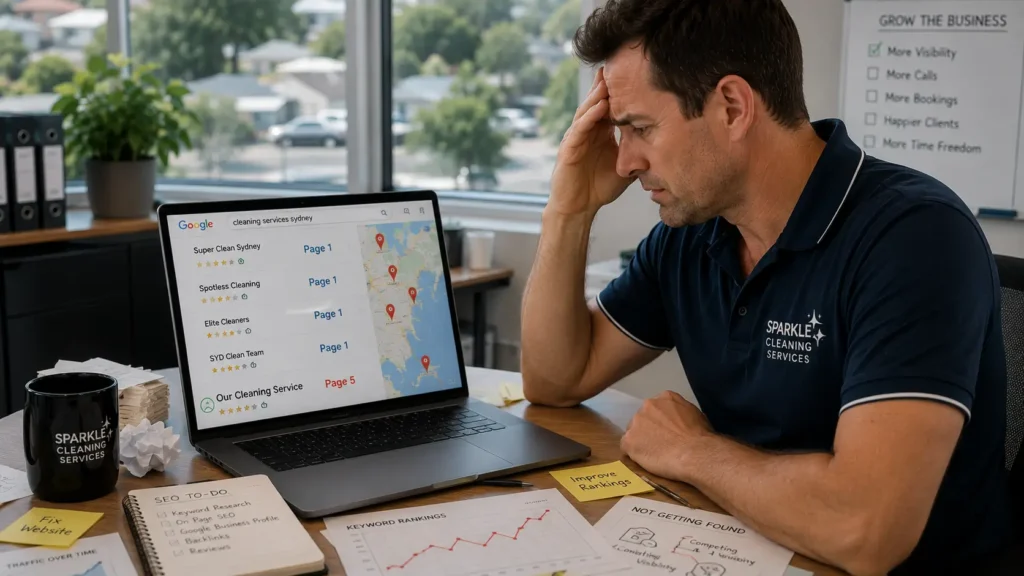
Many cleaning businesses don’t struggle because they lack effort. They struggle because their SEO strategy is incomplete. Some focus only on keywords while ignoring technical issues. Others invest in content but neglect local SEO. Some improve rankings but still fail to convert visitors into enquiries. This is where a complete strategy makes the difference.
At MH WebMark, we help cleaning businesses build SEO systems designed around one goal: generating more qualified bookings from search. We don’t treat SEO as just rankings or traffic. We focus on visibility, authority, and conversions together because all three are essential for sustainable growth.
Technical SEO
Technical SEO forms the foundation of strong search performance. A slow, poorly structured, or difficult-to-crawl website creates barriers for both users and search engines. We help businesses improve site speed, crawlability, mobile performance, page structure, and technical health so search engines can properly understand and rank their websites.
Local SEO
For cleaning businesses, local SEO is often where the biggest growth opportunities exist. We optimize Google Business Profiles, local citations, service-area relevance, and local landing pages to improve visibility in Google Maps and local search. This helps cleaning businesses attract nearby customers actively searching for services.
Lead Generation Strategy
Traffic alone doesn’t grow businesses—conversions do. That’s why we also focus heavily on turning visitors into enquiries. Through conversion-focused website improvements, better calls-to-action, stronger trust signals, and optimized user journeys, we help businesses convert organic traffic into real leads. When SEO, local visibility, and conversion strategy work together, growth becomes much more predictable.
Final Thoughts
SEO for cleaning services is not about ranking for the most keywords or generating random traffic. It’s about showing up for the right searches—the searches made by people who genuinely need your services. That’s the difference between vanity SEO and growth-focused SEO. The cleaning businesses that consistently generate leads from Google are usually not the ones chasing shortcuts. They are the businesses building strong SEO foundations, improving local visibility, publishing helpful content, and creating websites that convert visitors into customers.
Over time, that creates a powerful advantage. Better rankings lead to more visibility. More visibility brings more qualified traffic. More qualified traffic creates more enquiries. And more enquiries drive sustainable business growth.
If your cleaning business isn’t getting enough leads from Google, the problem may not be your service quality. It may simply be that your SEO strategy isn’t working as effectively as it should. If you want expert help improving rankings and generating more bookings, Contact Us and let’s discuss how MH WebMark can help build an SEO strategy designed for long-term growth.
FAQ Section
What is SEO for cleaning services?
SEO for cleaning services is the process of improving your website and online presence so your business appears higher in Google search results when people look for cleaning services. This includes optimizing your website, improving local SEO, targeting the right keywords, and building trust signals such as reviews and backlinks. The goal is simple: help more potential customers find and contact your business online.
Why is SEO important for cleaning businesses?
SEO is important because most customers now search online before hiring a cleaning company. Whether someone needs residential cleaning, office cleaning, or end-of-lease cleaning, their first step is usually a Google search. If your business doesn’t appear in those results, you’re missing potential leads. Strong SEO improves visibility and helps bring consistent enquiries without relying entirely on referrals or paid ads.
How long does SEO take for a cleaning business?
SEO is a long-term strategy, so results don’t happen overnight. In most cases, cleaning businesses start seeing meaningful improvements within three to six months, depending on competition, website quality, and current online presence. Highly competitive markets may take longer. The businesses that stay consistent with SEO usually see the strongest long-term results.
Does local SEO help cleaning companies get more clients?
Yes, absolutely. Local SEO is especially important for cleaning businesses because customers usually search for providers in their own area. Strong local SEO helps your business rank better in Google Maps and local search results, making it easier for nearby customers to find you. This often leads to more calls, quote requests, and bookings.
What keywords should cleaning businesses target?
Cleaning businesses should focus on high-intent keywords that reflect both services and locations. For example, keywords like “office cleaning Sydney,” “commercial cleaners Parramatta,” or “end-of-lease cleaning near me” usually attract stronger leads than broad informational searches. The best keywords are the ones used by people who are actively looking to book a cleaning service.