For a time getting online and being seen meant ranking high on Google. If your business was on the page for important words you had a good chance of getting visitors leads and sales. That’s why Search Engine Optimization (SEO) became a digital marketing strategy for businesses everywhere. Things have changed.
Now people are using AI tools like ChatGPT, Google Gemini, Perplexity and Microsoft Copilot more instead of traditional search engines. They are asking questions like they are talking to a real consultant instead of typing short search queries.
- For example of searching for “best SEO agency Australia,”
- users now ask:
- “Which SEO agency in Australia is best?”
“How can I get more leads without spending too much on ads?” This may seem like a small change but it makes a big difference. Traditional search engines show a list of links. Let users choose what to click. AI search works differently. It looks at sources, decides which ones are trustworthy and gives users a direct answer. That’s where Generative Engine Optimization (GEO) comes in. Many business owners are now asking: Is GEO replacing SEO? The answer is no. SEO is not dead. Geo is not here to replace it. GEO is the step in digital visibility. Businesses that understand both GEO and SEO will have an advantage in 2026 and beyond.
At MH WebMark we think of GEO and SEO as two sides of the coin. One helps you rank in search engines while the other helps you be visible, in AI-generated answers. The future belongs to businesses that optimize for both GEO and SEO.
What Is Search Engine Optimization?
Search Engine Optimization is something that has been around for a time. It is the process of making a website so it shows up higher on search engines like Google and Bing. The goal of Search Engine Optimization is simple: when someone searches for something your website should show up near the top. When your website is more visible you usually get more people visiting your website more people asking about your business. You make more money.
For example if someone searches for ” digital marketing agency in Sydney” or “Search Engine Optimization services in Australia” Google looks at millions of web pages and decides which ones are the best. This decision is based on things, including how relevant your website is to what people are searching for, how many other websites link to your website, how well your website works how good your content is and how easy it is for people to use your website. Businesses that put time and money into Search Engine Optimization have a chance of showing up where people are already looking.
Search Engine Optimization has always been about helping people find websites when they search for something. In words Search Engine Optimization works when people click on your website. The better your website ranks the likely people are to visit your website. Today Search Engine Optimization is one of the best ways for businesses to grow online.
What Is Generative Engine Optimization?
Generative Engine Optimization is the step in making your business visible online. Of just focusing on making your website show up in search results Generative Engine Optimization helps your business show up in answers that are generated by artificial intelligence. This includes things like ChatGPT, Google Gemini, Perplexity and Microsoft Copilot where people are starting to search for things by having conversations of just typing in keywords.
Think about how people use intelligence today. Of searching for “Search Engine Optimization agency Sydney” they might ask “Which Search Engine Optimization agency in Sydney is best for a small business that does not have a lot of money?” That is a different way of searching for things. Artificial intelligence systems look at that question analyze information from different sources and give a direct answer. A lot of the time people do not even look at a list of search results.
This creates a challenge for businesses. Your business is not just competing to show up in search results. It is competing to be a source that intelligence systems trust. Generative Engine Optimization helps your business become one of those trusted sources by making your website more authoritative improving the structure of your content making your website easier to use and building trust with people who visit your website.
Unlike Search Engine Optimization, Generative Engine Optimization is more about being clear being trustworthy and providing information. Artificial intelligence systems like content that’s easy to understand easy to read and gives direct answers. The clearer and more trustworthy your content is, the likely artificial intelligence systems are to use it in their answers.
Generative Engine Optimization vs Search Engine Optimization: What Are The Differences
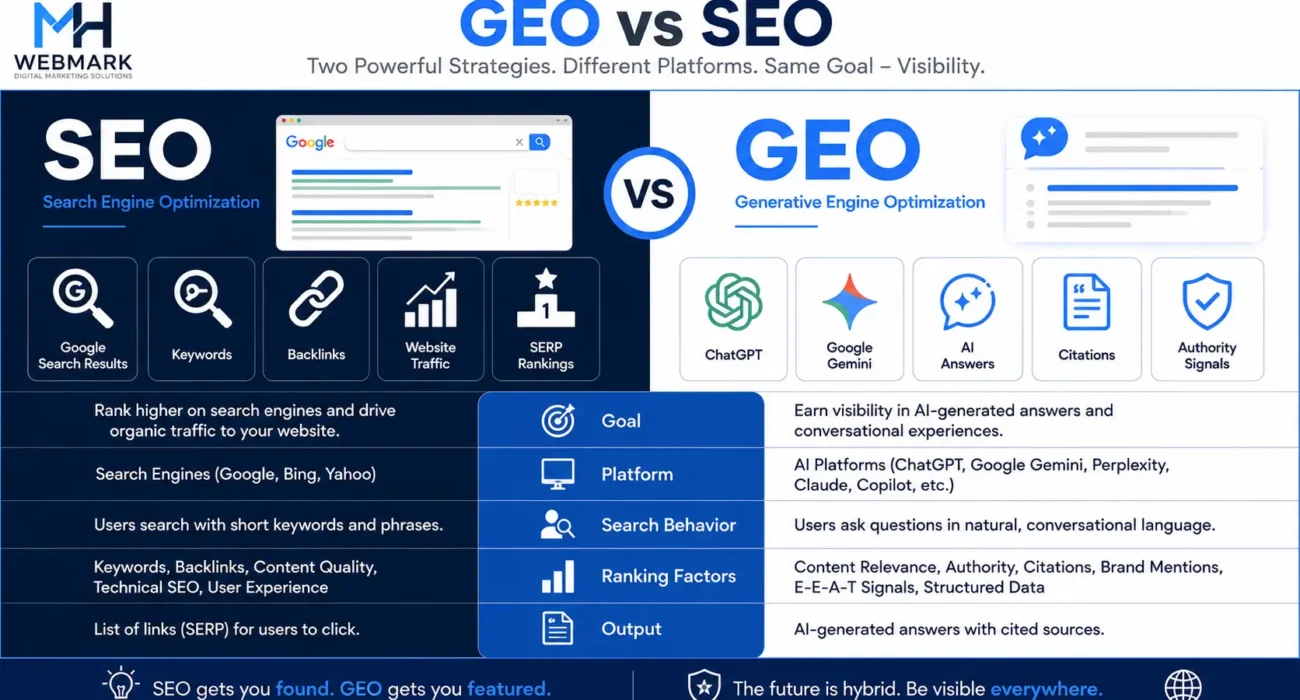
Even though Generative Engine Optimization and Search Engine Optimization have the goal of making your business more visible they work in different ways. Search Engine Optimization is designed for search engines that show a list of websites. Generative Engine Optimization is designed for intelligence systems that give one answer to a question.
The biggest difference between Generative Engine Optimization and Search Engine Optimization is how you measure success. With Search Engine Optimization success means your website shows up near the top of search results you get more visitors and people click on your website more. With Generative Engine Optimization success means your business is cited, mentioned or used as a trusted source in answers generated by intelligence. Of trying to be in the top ten search results businesses are competing to be one of the few sources that artificial intelligence systems think are trustworthy.
Another big difference is how people behave when they search for things. Traditional search is about typing in keywords to find information. Artificial intelligence search is like having a conversation and is more about the context of what you are searching for. People ask longer specific questions and expect to get precise answers. Because of this content for Generative Engine Optimization needs to be natural focus on giving answers and be more informative than content for Search Engine Optimization.
The things that artificial intelligence systems look for are also different. Search Engine Optimization still relies heavily on keywords links from websites how well your website works and how people interact with your website. Generative Engine Optimization is more about being trustworthy having structured content being a brand that people trust being cited by sources and being recognized as an entity. Artificial intelligence systems do not care much about keywords as they do about whether your content gives the best answer.
This does not mean that Generative Engine Optimization replaces Search Engine Optimization. In fact both strategies work together. Having Search Engine Optimization helps people find your website in traditional search results while having strong Generative Engine Optimization helps your business show up in answers generated by artificial intelligence. Businesses that use both strategies will be in the position as search continues to change in 2026 and, beyond.
How Search Behavior Is Changing in 2026
The way people search online is changing a lot. This shift is one of the reasons GEO is becoming very important. For a time users searched online by typing short phrases like “best SEO agency Sydney” or “digital marketing services Australia.” Search engines then showed a list of webpages and users browsed through many links to find what they needed.
Now things are changing fast. More users are using AI-powered platforms because they want direct answers. Of comparing many websites they ask detailed questions and get a summarized response in seconds. For example a business owner might ask ChatGPT “Should I invest in SEO or Google Ads for my cleaning business?” instead of searching articles and comparing opinions manually.
This shift from keyword-based search to search changes how businesses think about content. Traditional SEO content was built around keywords. While keywords still matter AI-driven search focuses more on context, intent and answer quality. AI systems try to understand not the words users type but the real problem behind the question.
Another big change is clicks. In search users clicked through to websites to find answers. In AI search users often get answers directly inside the platform without visiting a webpage. This creates a competitive environment where just ranking is not enough. Businesses now need content enough to become part of the AI-generated answer itself.
For businesses this means visibility is not just about Google rankings anymore. The future of visibility depends on appearing wherever users search for answers—whether that is Google, ChatGPT, Gemini, Perplexity or the next AI platform. Businesses that adapt early, to this change will have an advantage. Those relying on traditional search strategies may lose visibility as AI adoption grows.
Is GEO Replacing SEO?
One big misconception in marketing is that GEO will completely take over SEO. As AI search grows many business owners ask if traditional SEO is becoming old. The short answer is no. GEO is not replacing SEO. Instead GEO is making search diverse and adding a new layer to online visibility. SEO is still important because Google handles billions of searches daily. People still search for products, services, local businesses, reviews and more using search engines. If your website isn’t optimized for SEO you’re missing lots of traffic.
Whats changing is how people find information at the start of their journey. More users now start with AI tools, not search engines. They ask questions seek recommendations compare solutions and want answers. This is where GEO becomes important. Think of SEO and GEO as working not against each other.
SEO helps your website rank in search engines and drives traffic to your pages. GEO helps AI systems understand your expertise and makes it more likely that your content is used in generated answers. One brings visibility through rankings; the other brings visibility through recommendations. A simple way to understand this is to think of SEO as optimizing for search engines and GEO as optimizing for AI assistants.
Businesses that focus on SEO may still rank well on Google but miss out on AI search opportunities. On the hand businesses focusing only on GEO while ignoring SEO risk losing traffic from traditional search. The strongest position comes from combining both.
At MH WebMark we believe the future is not SEO, versus GEO. It’s SEO plus GEO. Businesses that build technical SEO foundations, authoritative content, structured data and trusted brand signals will do better in both traditional and AI search. In 2026 and beyond the real winners will not be the businesses choosing one over the other. They will be the ones enough to adapt to both.
When Should Businesses Focus on SEO?
SEO is still very important for businesses with all the new AI search tools. People still use search engines like Google to find things especially when they want to buy something. When someone is ready to make a purchase they will often search for things like “SEO agency near me” or “best accountant in Sydney”. They are looking for a service. Want to visit websites compare options and read reviews.
For example if someone searches for “WordPress developer in Australia” they are probably close to making a decision. They want to find a service provider and will often contact businesses directly. This is where SEO really helps. Businesses should focus on SEO when they want more people to visit their website improve their search rankings and get leads from search engines.
SEO is especially good for businesses, people who sell services, online stores and companies that operate in very competitive markets. Good SEO helps your website show up when people are searching for things. SEO also helps build a foundation for your website. Things like how fast your website is, if it works well on phones and if it is easy to navigate are all important.
These things also help with GEO because AI systems like well-organized content. Another good thing about SEO is that it keeps working over time. Unlike paid ads, where you stop getting noticed when you stop paying SEO keeps giving you results for months or even years. This makes SEO a good way to grow your business in the long term.
In terms businesses should focus on SEO when they want to be higher up on search engines get more organic traffic and attract people who are ready to buy. While GEO is getting more important SEO is still the base of being visible and should not be ignored. Businesses should prioritize SEO when their main goal is to rank on search engines attract organic traffic and capture users who are looking for things like SEO agency near me or best accountant, in Sydney.
When Should Businesses Focus on GEO?
Businesses should start focusing on GEO when they want to be seen by people in search results that use artificial intelligence and be known as experts in their field. As tools like ChatGPT, Google Gemini, Perplexity and Microsoft Copilot change how people find information it is a plus to show up in answers that these tools give.
GEO is really important for businesses that deal with information or need to be trusted, like marketing agencies, consultants, law firms, healthcare providers, financial services, SaaS companies and professional service businesses. In these fields customers usually ask a lot of questions before making a decision to buy. Of just typing in a few words they ask AI tools for advice, comparisons and expert opinions.
For example a business owner might ask, “What marketing plan works better for a cleaning company?”. What is the best SEO agency in Australia for small businesses?” In these cases AI tools look at sources and only pick a few trusted websites to help give the final answer. If your business is not seen as a source you might not show up in those answers. GEO is also good for businesses that want to be seen as authorities in their field not just get more people to visit their website. The usual way of doing SEO looks at how many people click and how high you rank. Geo is about being recommended by AI. Even if people do not click on your website away seeing your business mentioned by AI can help build trust and credibility faster.
Another good reason to use GEO is to get ready for the future of strategy. The way people search for things is changing to be like talking to someone and this will keep happening over the next few years. Businesses that start optimizing for AI now will be seen as authorities sooner. Will have a stronger position before things get more competitive.
In terms businesses should focus on GEO when they want to be more than just something people can find. They want to be recommended. Companies that become authorities publish content that AI can use and build trust now will have a big advantage in the future of search. GEO helps businesses become the go-to choice for people looking for information. By focusing on GEO businesses can make sure they are seen as trusted sources by AI tools and users. This is especially important, for businesses that deal with GEO as it can make or break their presence.
MH WebMark’s Hybrid Strategy: Combining GEO and SEO
At MH WebMark we think that GEO and SEO are two parts of being visible online. We do not think they are opposing strategies. Businesses that only focus on SEO may not be seen in search results that use artificial intelligence. On the hand businesses that only focus on GEO may miss out on people visiting their website from search engines. The best approach in 2026 is to use both GEO and SEO
We call this approach the MH WebMark Hybrid Visibility Framework. This framework is based on the idea that businesses need to be ready for the future by optimizing for both search engines and artificial intelligence platforms at the same time. Of choosing between GEO and SEO businesses should create a strategy that uses the strengths of both GEO and SEO.
The first part of our framework is SEO. This means creating a website that’s fast easy to navigate and works well on mobile devices. The website should also have a structure, optimized metadata and clear links between pages. Technical SEO helps search engines and artificial intelligence systems understand website content better.
The second part is creating content that’s valuable and trustworthy. Businesses should publish content that answers questions solves problems and shows expertise. This can include guides, comparisons, case studies and original ideas. Content that offers value is more likely to be ranked high on Google and cited by artificial intelligence systems.
The third part is building trust. Getting cited by other websites. Artificial intelligence systems prefer businesses that are trusted. This means businesses need to have a reputation online including links from other websites, mentions, reviews and consistent information about the business. The stronger these trust signals are, the likely artificial intelligence systems are to consider the business credible.
The final part is optimizing for intelligence. This means structuring content in a way that artificial intelligence systems can easily understand. Clear headings, direct answers and concise explanations are important. Content that is clear and well-written is more likely to be referenced in answers generated by intelligence.
When these four parts work together businesses can be seen in both search results and artificial intelligence recommendations. They can rank high for keywords on Google and increase their chances of being recommended by artificial intelligence tools.
In terms SEO helps people find your website while GEO helps artificial intelligence recommend your business. Businesses that are good at both SEO and GEO will be the ones that succeed in search results in 2026 and beyond. MH WebMark’s Hybrid Strategy is, about combining GEO and SEO to achieve this success.
conclusion
The debate around GEO versus SEO is not about picking one over the other. It is about understanding how search is changing and adapting to it. Traditional SEO is still very important for marketing. This is because search engines like Google bring a lot of traffic to websites. Businesses that want to grow rank higher and get more leads need to focus on SEO.
At the time AI-powered platforms like ChatGPT, Google Gemini, Perplexity and Microsoft Copilot are changing how people find information. Users are asking questions. Expecting direct answers instead of visiting many websites. This change makes GEO more important than ever. The main difference is simple: SEO helps your website rank higher while GEO helps your business get recommended by AI.
The businesses that will succeed in 2026 and beyond will not be the ones that choose between GEO and SEO. They will be the ones that use both in a strategy. Having a website, good content, structured data and a trusted brand will be key to success in the next era of search.
At MH WebMark we think the future of visibility is about being not just searchable but also recommendable. The sooner businesses prepare for AI-driven search the stronger they will be compared to their competitors. The future of search is here. The real question is: is your business ready, for it?